Mizuki Ozawa and Yuko Matsunaka’s name tags
Blind Willow, Sleeping WomanMizuki Ozawa and Yuko Matsunaka’s name tags are ordinary dormitory and workplace identifiers that become the material center of a story about identity and loss. Yuko asks Mizuki to keep her tag shortly before disappearing; later, both tags turn up together, stolen by a monkey whose desire to possess names links his attachment to Yuko with Mizuki’s episodes of forgetting her own. Their return ends the immediate mystery, but the two labels remain charged with the differences between a name one is given, one chooses to use, and one fears losing.
The Name Tag as an Everyday Identifier
In the dormitory where Mizuki was a senior and student representative, every resident’s name tag hung on a board at the entrance. The name was printed in black on one side and red on the other: turning it showed whether its owner was in the dorm or had gone out. If a student was staying elsewhere or on leave, the tag came off the board. The system let students staffing the front desk check a resident’s status at a glance, making the tag both a personal label and a small administrative record of presence and absence.
Mizuki’s own name was divided among several settings. She had married Takashi Ando and gradually grown accustomed to the name Mizuki Ando, but at work she continued to use her maiden name, Mizuki Ozawa. Changing the computer records and paperwork seemed too troublesome, so Ozawa remained on her business cards, name tag, and time card; colleagues addressed her by several versions of that name. Her husband knew and accepted the arrangement as convenient. The contrast matters: her name could be socially legible in more than one form, while the name tag later makes the loss of that legibility feel tangible.
Yuko Entrusts Her Tag
Yuko handed her name tag to Mizuki after saying that she was going home for a relative’s funeral. She expected to return by Monday, but her explanation was a lie: no relative had died, and no funeral took place. Yuko asked Mizuki to keep the tag because something was troubling her and she did not want it in her room. She added that she did not want a monkey to run off with it. Mizuki took the remark as an unlikely joke; Yuko then left the room, leaving the tag, an untouched cup of tea, and an unsettling absence.
Yuko never returned to the dorm. After the teacher responsible for her class contacted her parents, the dorm learned that she had never gone home. Her body was found the following week in the woods; she had died by suicide, and she left no note or clear explanation. The tag Mizuki had agreed to keep thus became the surviving object of an encounter whose meaning Yuko had not explained. Her casual-sounding warning about a monkey, once the theft is revealed, acquires an eerie literalness without supplying an answer to why she died.
Two Tags, One Disappearance
About a year before the investigation, Mizuki began having episodes in which she could not recall her own name. The blank came on especially when she was hurried or suddenly asked; struggling to retrieve the name only deepened it. Her memory otherwise remained intact, including her knowledge of other people’s names and of her address, phone number, birthday, and passport number. She could usually recover her identity by checking the license in her purse, but the episodes left her distressed by the possibility of being, for a time, a woman without a name.
When Mrs. Sakaki placed two recovered tags on the desk, Mizuki saw her own maiden name, Mizuki Ozawa, alongside Yuko Matsunaka’s. Mrs. Sakaki explained that the theft of both tags was the cause of Mizuki’s difficulty remembering her name, and that recovering them had allowed her to recover it. The paired objects made the connection visible: what had seemed like a private failure of memory was tied to the removal of a physical label, and Yuko’s tag had disappeared along with Mizuki’s.
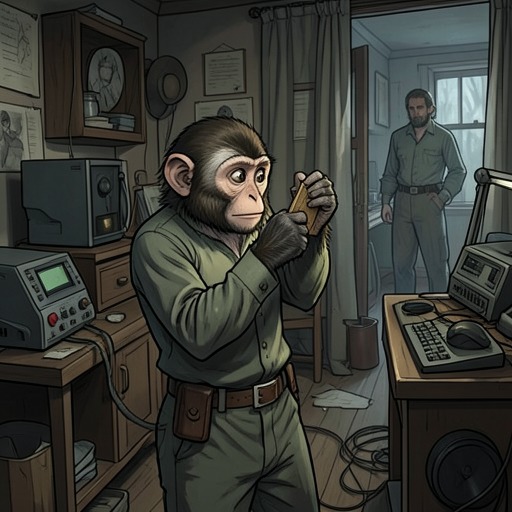
The monkey admitted that he had sneaked into Mizuki’s apartment and taken the tags around the time her name began slipping away. He described stealing names as an uncontrollable compulsion: when a name attracted him, he had to possess it. He had first wanted Yuko’s name because he was deeply in love with her and, unable to make her his, imagined that owning her name would satisfy him. Before he could carry out that plan at the dorm, Yuko died. Later, suspecting that she might have left the tag with Mizuki, he tracked Mizuki down and entered her home. He stole Mizuki’s tag too because her name moved him; his pursuit of one woman’s name therefore caused the loss of another woman’s name as well.
Return and Meaning
The recovered tags restore more than missing possessions within the plot: their return closes the immediate chain linking Yuko’s disappearance, the monkey’s theft, and Mizuki’s recurring blankness. Yet the story distinguishes the object from the person it identifies. Mizuki had continued to exist and retained much of her memory even when she could not summon her name; the tag makes that name available again, but it does not reduce her whole identity to a printed label. Its importance lies instead in how sharply the story shows the strain of that distinction: losing the name does not erase the person, but it can make her feel unmoored from herself.
As Mizuki says goodbye to the monkey, she gives him Yuko’s tag, telling him that he should have it because he liked Yuko. The gesture returns the object to the creature whose desire first made it significant, while separating possession from fulfillment: the monkey can hold Yuko’s name, but Yuko herself is gone. Mizuki’s own tag, meanwhile, has been recovered, and the two names no longer remain together as stolen property. The ending gives the tags different destinations and functions—one restores Mizuki’s practical hold on her name; the other becomes a final acknowledgment of the monkey’s attachment and Yuko’s absence.